
🔥 We are hearing more and more reports from various news sources about waste fires in Hungary. The public is becoming increasingly concerned about the occurrence of these fires – not so much because of the presumed financial damage, but rather because of the significant environmental impact they cause.
Waste processors have a direct stake in this in every respect, so it is in their vital interest to prevent such fires. The challenge is enormous; the activity itself is a dangerous technological trap. Lithium-ion batteries entering the compactor, spontaneous combustion deep within, and bales of paper smouldering from the inside trigger processes that are almost impossible to extinguish.
These fires often start when nothing is yet visible from the outside. Alongside the visible material damage – destroyed machinery, burnt-out buildings, disrupted logistics and millions in fire-fighting costs – the invisible environmental footprint of waste fires is also significant. Large quantities of toxic substances – such as dioxins, heavy metals and organic compounds – are released into the air, and the water used to extinguish the fires also contaminates the soil.
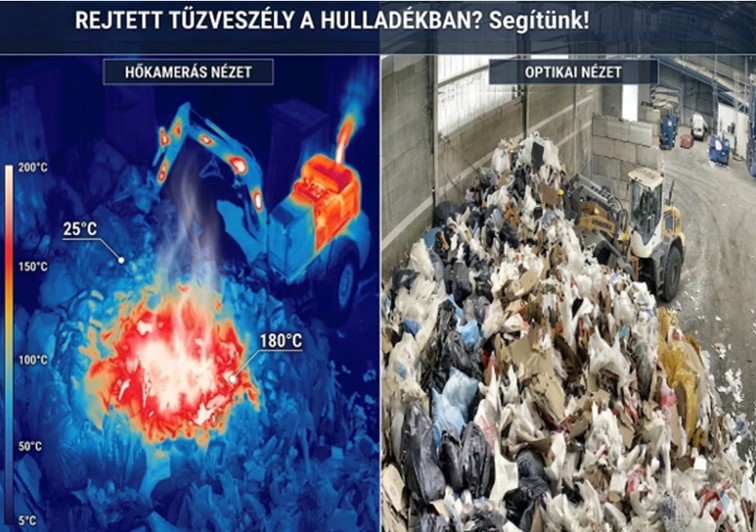
Under such conditions, conventional smoke detectors are unable to function properly, so we tested the products (thermal cameras) of four well-known camera manufacturers (Hikvision, Dahua, Mobotix, Safire) under real-world, extreme conditions: dust, moving machinery, outdoor environments, and sunlight – precisely where the problem arises. 🔥 One of the most important findings of the test is that the technology has taken a leap forward.
With the use of these devices, simple detection has been replaced by intelligent recognition. These thermal cameras no longer just monitor heat; instead, with the help of AI, they analyse what is happening in the observed area within both the visible and the invisible long-wave infrared spectrum.
Key findings from the test: • Dual-spectrum fusion The combination of thermal and optical images improved identification for all devices. We see not just ‘hot spots’, but the precise surroundings as well. • Temperature measurement Although all cameras can provide early fire detection, only the top-of-the-range models offered stable and accurate °C-based decision support. • Flame and smoke detection Flame detection is excellent, but smoke detection in windy conditions or against a bright background remains a technological challenge. • Intelligent machinery filtering (Forklift filter): In active sites, hot exhaust pipes are a constant source of interference.
The AI algorithms of some systems are capable of distinguishing between normal operational heat and fire hazards, thereby drastically reducing false alarms. However, running the forklift filter and smoke detection in parallel requires significant processing power – based on our tests, only the most advanced premium systems can handle this reliably! All the thermal cameras tested are available in our range.
If you have any questions about the future of early fire detection, please feel free to contact our colleague Tamás Gyenes!